

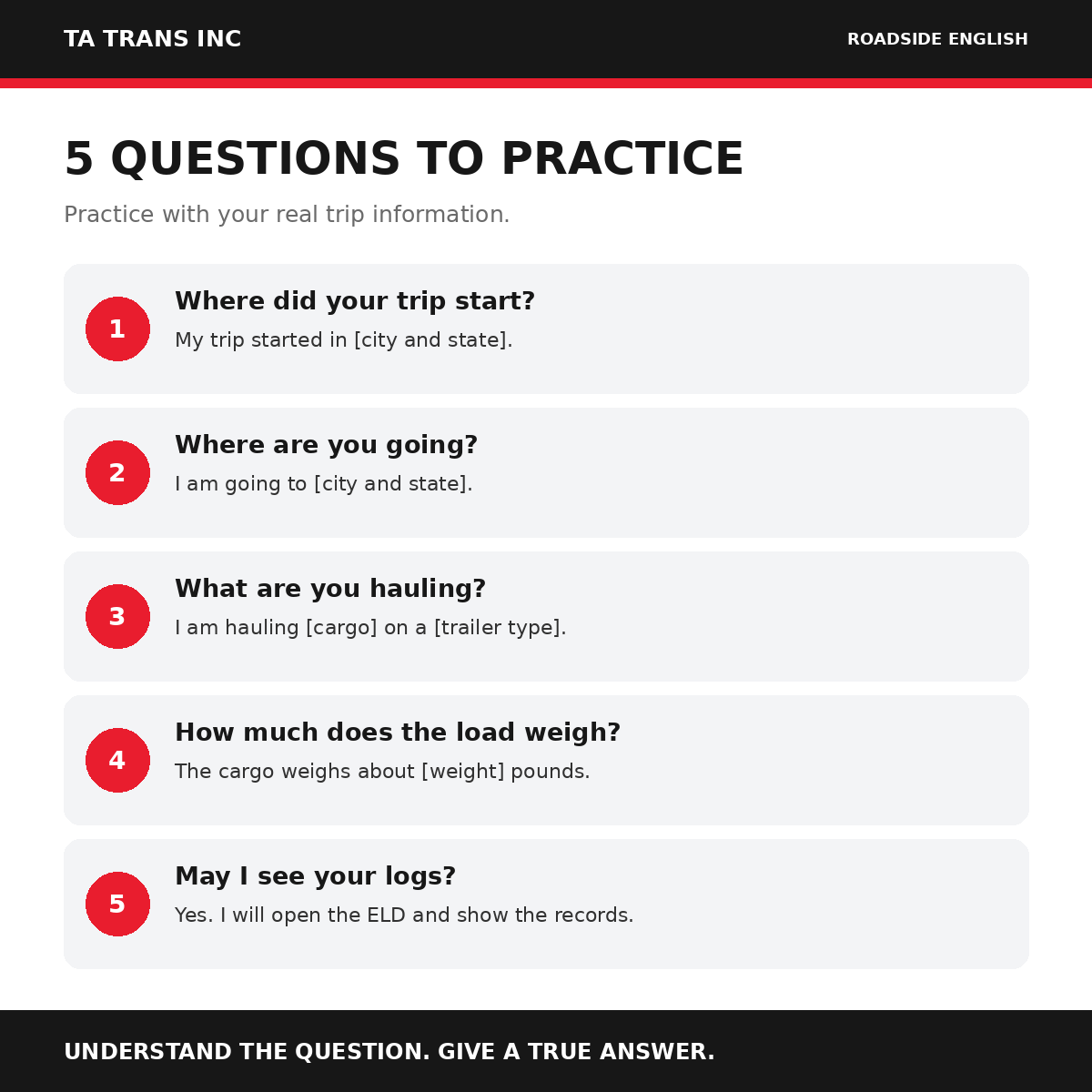
An inspector asks, “Where did your trip start?”
You understand the question, but you need time to find the English
words. You reach for your phone to open a translation app.
That can become a serious problem during an English-language
check.
FMCSA guidance says an inspector should not use a translation app,
interpreter, cue card or telephone translation service to help a driver
complete the English interview. The driver must understand the questions
and answer in English.
You do not need perfect grammar. You do not need a perfect American
accent. But you must be able to talk about your trip, load, logbook,
license and truck. You must also understand important highway signs.
This guide gives you simple questions and answers to practice before
an inspection. These are practice examples—not a complete or official
list of questions an inspector must use.
Quick
answer: What English does a truck driver need at an inspection?
A commercial driver should be able to:
- Understand an inspector’s instructions
- Answer questions about the trip and destination
- Explain what the truck is hauling
- Discuss driving time and duty status
- Find information on the CDL, logbook and shipping papers
- Name important truck and trailer parts
- Read and explain highway signs in English
FMCSA’s current roadside process starts with an interview in English.
If the driver cannot answer well enough, the inspector should stop the
assessment and cite the violation. The driver may be placed out of
service.
For a full explanation of the process, read FMCSA’s
Two-Step English Proficiency Test: What Changed in 2026.
15 English
questions truck drivers can practice
FMCSA does not publish one fixed script that every inspector must
follow. However, its guidance says drivers should be ready to discuss
the trip, hours of service, license, shipping papers and vehicle
equipment.
Practice answering in full, simple sentences. Change the details so
they match your real trip.
Questions about you and
your documents
1. May I see your commercial driver’s license?
“Yes, officer. Here is my CDL.”
2. What class of CDL do you have?
“I have a Class A CDL.”
3. Do you have any endorsements?
“Yes. I have a tanker endorsement.”
or
“No. I do not have any endorsements.”
4. Is the address on your license current?
“Yes, the address is current.”
Questions about your route
and load
5. Where did your trip start?
“My trip started in Gary, Indiana.”
6. Where are you going?
“I am delivering this load in Atlanta, Georgia.”
7. What are you hauling?
“I am hauling steel coils on a flatbed.”
8. Where are your shipping papers?
“The shipping papers are in the passenger-side door pocket.”
9. How much does the load weigh?
“The cargo weighs 42,000 pounds.”
Do not guess. Check your bill of lading, permit or other shipping
document when needed.
Questions about hours of
service
10. What is your current duty status?
“I am on duty for an inspection.”
11. What time did you start driving today?
“I started driving at 6 a.m.”
12. When was your last break?
“My last break started at 11:30 a.m.”
13. Please show me your electronic log.
“Yes, officer. I will open today’s log.”
The driver should know how to open the required ELD screens and send
or display records without depending on another person.
Questions about the truck
14. Did you complete a pre-trip inspection?
“Yes. I completed my pre-trip before I started driving.”
15. Did you find any defects?
“No defects were found.”
or
“Yes. I reported a damaged light, and it was repaired before the
trip.”
Always give a truthful answer. A memorized answer that does not match
the truck, paperwork or log can create a bigger problem.
Simple instructions
you should understand
An inspection includes instructions, not only questions. Practice
these common directions:
- Pull forward slowly.
- Set the parking brake.
- Turn off the engine.
- Turn on your headlights.
- Turn on your four-way flashers.
- Apply the service brake.
- Release the brakes.
- Open the hood.
- Show me your logbook.
- Stay inside the cab.
- Step out of the truck.
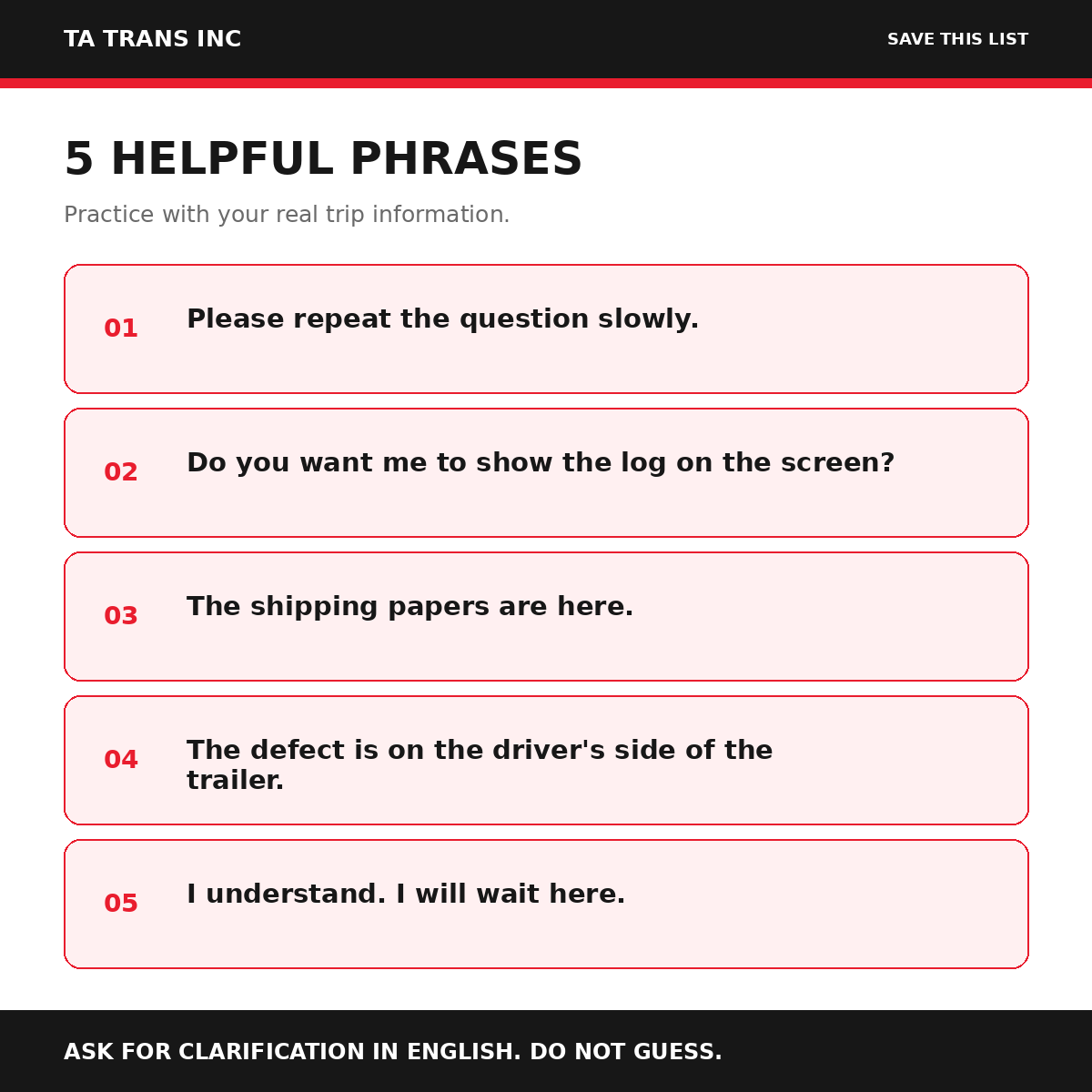
Ask for the instruction again if you did not hear it clearly. You can
say:
- “Please repeat the question.”
- “Please speak more slowly.”
- “Do you want me to pull forward?”
- “Do you want the truck turned off?”
Asking an inspector to repeat or clarify a question in English is
better than pretending you understood it.
Truck words worth practicing
Drivers should know the English names for equipment an inspector may
check:
- Air lines
- Brakes
- Cargo securement
- Chains and binders
- Coupling
- Fire extinguisher
- Fifth wheel
- Headlights
- Kingpin
- Landing gear
- License plate
- Mud flaps
- Reflective tape
- Suspension
- Tires
- Trailer lights
- Warning triangles
- Windshield and wipers
Open-deck drivers should also be able to explain their cargo and
securement. For example:
“The load is secured with four chains and four binders.”
“The tarp is secured, and there are no loose straps.”
“I checked the securement after the first 50 miles.”
Use only statements that are true for the load in front of you.
Road signs drivers
should be able to explain
The second part of the FMCSA assessment checks whether a driver
understands U.S. highway signs, including electronic message signs.
FMCSA does not publish a complete public list of the signs an inspector
will select.
Practice reading and explaining common signs such as:
- No Trucks: Trucks cannot use this road.
- Truck Route: Trucks should follow this route.
- Low Clearance: The road has a height limit
ahead. - Weight Limit: Vehicles over the posted weight
cannot continue. - Steep Grade: A steep hill is ahead. Choose a safe
speed and gear. - Road Closed: Do not continue on this road.
- Detour: Follow the temporary route.
- Lane Closed Ahead: Move safely into an open
lane. - Stop Ahead: Prepare to stop.
- Weigh Station Open: Commercial trucks must enter as
required.
Do not learn only the shape or color. Practice saying what the sign
requires you to do.
Can you
use a translation app after the English check?
Not during the English interview. FMCSA says tools such as
interpreters, cue cards and smartphone translation apps should not be
used because they may hide whether the driver can communicate in
English.
After the driver passes the English assessment, an inspector may
choose communication methods that help complete the rest of the
inspection safely. That does not mean a phone can replace the required
English ability.
Read CDL
English Test Requirements: What FMCSA Really Requires for more
information about the underlying driver qualification rule.
The
TA Trans perspective: Practice job English, not difficult grammar
Many professional drivers in the United States speak more than one
language. An accent does not make someone an unsafe driver, and perfect
grammar is not the goal.
The practical goal is clear communication during real work:
- Know your trip and load information
- Understand safety instructions
- Explain your log and documents
- Recognize road signs
- Report a defect clearly
- Ask for clarification in English when needed
Practice for 10 minutes at a time. A dispatcher, safety manager or
another driver can ask the questions while the driver answers without
looking at a prepared script. Change the order and wording so the driver
learns the meaning—not only one memorized answer.
At TA Trans, preparation matters before the truck reaches the scale
house. Drivers who need help with inspection vocabulary should speak
with the safety team before their next trip.
Interested in driving flatbed, step deck or stretch freight with TA
Trans? Review our current requirements on the Join TA Trans page.
Free roadside English practice guide
Download the four-page guide with common inspection questions, road signs, truck words and useful phrases. Keep it on your phone or print it for practice. No email is required.
Quick roadside
English practice checklist
- Explain today’s origin and destination
- Name the cargo and its weight
- Find information on the CDL and shipping papers
- Explain current duty status and recent driving time
- Open and display the correct ELD records
- Name important truck and trailer parts
- Follow basic inspection instructions
- Explain common road signs in simple English
- Practice without a translation app
- Give answers that match the real trip and paperwork
Frequently Asked Questions
Does a truck driver need perfect English?
No. The regulation does not require perfect grammar or a specific accent. The driver must read and speak English well enough to answer official questions, understand highway signs, speak with the public and complete required records.
Can I use Google Translate during the roadside English interview?
No. FMCSA guidance says smartphone apps, interpreters, cue cards and telephone interpretation services should not be used during the driver interview.
Are these the exact questions an inspector will ask?
No. Inspectors do not use one public fixed script. These practice questions are based on the topics FMCSA says carriers and inspectors may review, including the trip, logbook, license, shipping papers and vehicle equipment.
What happens if I do not pass the English assessment?
The inspector may cite the driver and place the driver out of service under the current enforcement criteria. A limited exception applies to certain trips that remain inside U.S.-Mexico border commercial zones.
Does the driver take the road-sign part after failing the interview?
No. FMCSA’s April 2026 FAQ says that when a driver cannot answer official questions well enough in the first step, the inspector should not continue to the road-sign step.